Cardiovascular Therapeutics
Targeting TRPV1
in heart failure
Makai develops TRPV1 antagonists for cardiovascular disease. In preclinical pressure-overload models, TRPV1 contributes to cardiac hypertrophy and heart-failure progression, and orally delivered TRPV1 antagonists reverse already-established cardiac dysfunction in mice. The work rests on target-biology and method-of-use intellectual property exclusively licensed from the University of Hawaii.
TRPV1 is a physical component of the cardiac natriuretic-peptide receptor (NPR1 / cGMP / PKG) signalling complex. In mouse pressure-overload models, orally delivered TRPV1 antagonists reduce atrial natriuretic peptide and reverse already-established cardiac dysfunction.
TRPV1 Ion Channel Discovery
Twenty years of research revealed that TRPV1—best known for detecting chili pepper heat—drives heart failure progression.
The Discovery
Heart failure affects nearly 6.7 million US adults, and current drugs slow its progression rather than reverse it. TRPV1—the channel best known for sensing chili-pepper heat—is also expressed in cardiac tissue, where it contributes to pressure-overload hypertrophy and heart-failure progression. Removing TRPV1 function, genetically or pharmacologically, is protective in preclinical models.
- Every oral/systemic TRPV1 antagonist tested — BCTC, SB366791 and AMG9810, three structurally distinct molecules — reversed the early loss of cardiac function after pressure overload; the effect tracks the target, not one compound.
- Oral BCTC, started after loss of function was established, reversed fractional shortening within weeks and held function above vehicle to 32 weeks.
- With treatment, less of what drives failure: heart-weight gain, cardiomyocyte hypertrophy, fibrosis, ANP, inflammation and tissue remodelling.
- Healthier animals — body weight significantly higher through 32 weeks (P<0.0001).
- TRPV1-null mice are protected from pressure-overload hypertrophy.
- The TRPV1–NPR1 interaction and PKG phosphorylation of TRPV1 are demonstrated biochemically; the broader cardiac mechanism remains a proposed model.
- Independent human signal: a Pila Pharma Phase 2 trial of a TRPV1 antagonist reported reduced ANP.
Proposed mechanism: TRPV1 in the natriuretic-peptide signalling complex
TRPV1 physically associates with the natriuretic-peptide receptor NPR1. In the proposed model, ANP → NPR1/GC → cGMP → PKG phosphorylates and inhibits TRPV1. The interaction and the phosphorylation are shown biochemically; the cardiac cell type and the precise site of action are not yet defined. What is clear functionally is the outcome: blocking TRPV1 — pharmacologically or genetically — reduces calcium entry and is protective in these models.
Structure-based animation of the proposed model — plays when scrolled into view; click to pause or resume. Molecular shapes are PDB-derived; domain assembly, binding poses and motion are illustrative, and molecules are enlarged for clarity.
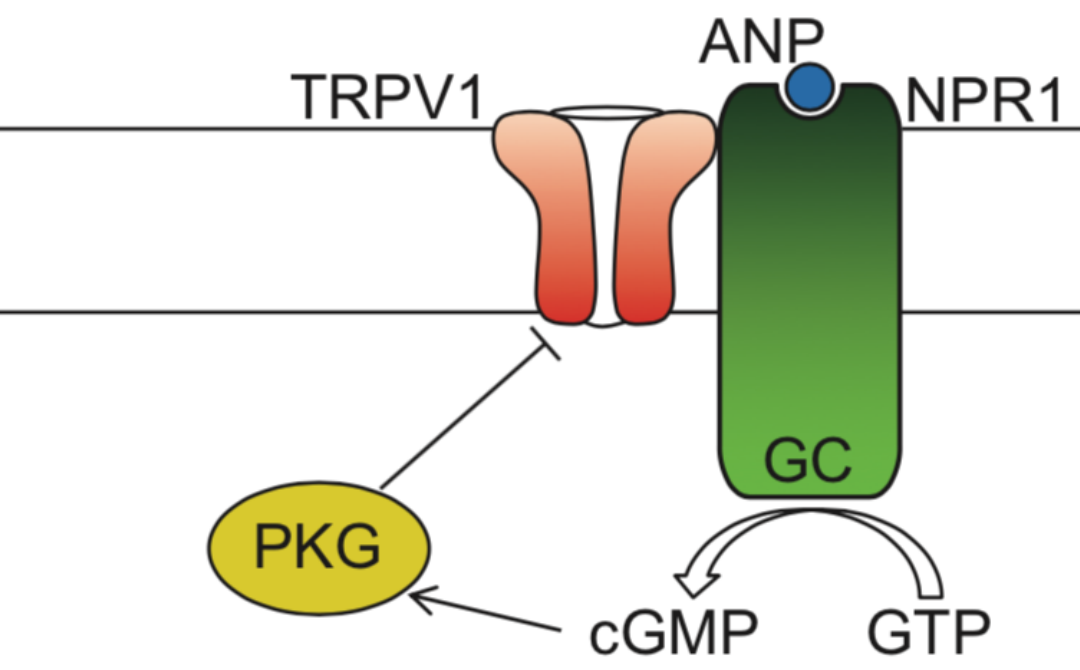
Figure 1 from Horton et al., Channels 2019. The TRPV1–NPR1 interaction, ANP-driven cGMP/PKG signalling, and PKG phosphorylation of TRPV1 are each demonstrated biochemically and electrophysiologically in the same paper.
TRPV1 antagonism reverses and maintains cardiac function after pressure overload
Mouse transverse aortic constriction (TAC) model. Antagonists were given orally one week after TAC — only after loss of function was established, so the design tests reversal of existing disease, not prevention. Three structurally distinct TRPV1 antagonists reverse the early decline; BCTC was followed to 32 weeks.
Redrawn from Horton et al., Channels 2019 (Fig. 5), building on Channels 2013. Mouse data, n = 5 per group; antagonists dosed orally from week 1 after TAC. ∗ p<0.05, ∗∗ p<0.01 vs vehicle. Trends read from the published figures — see the source papers for the primary data.
What the preserved function could mean in the clinic
- A class effect, not one drug. The aortic band is never removed — permanent pressure overload — yet all three TRPV1 antagonists (BCTC, SB366791, AMG9810) reversed the early loss of function. The arm followed longest held function above vehicle to 32 weeks.
- The benefit. At 3 weeks post-banding (2 weeks post-treatment), every drug produced a benefit of ~8–11 EF points over vehicle (AMG9810 ~8; SB366791 ~10; BCTC ~11). Only BCTC was followed to 32 weeks, sustaining ~7 points.
- In the clinic. EF preservation of this magnitude would be clinically meaningful.
Selected peer-reviewed work
Leadership & Expertise
The scientific leadership, strategic partners, and intellectual-property counsel behind the programme.
Alexander J. Stokes
University of Hawaiʻi at Mānoa ⋅ Cardiovascular Ion Channel Research Laboratory
25+ years in ion-channel research at Harvard Medical School, the Imperial Cancer Research Fund, and the University of Hawaiʻi at Mānoa, where the cardiac TRPV1 work was carried out. Two Nature papers; h-index 26; continuously federally funded since 1999 (NIH, NSF). Fellow of the Royal Society of Biology and the Royal Society of Medicine; National Academy of Inventors (Hawaii chapter). Identified TRPV1's role in cardiac hypertrophy and heart failure.
Key Partners & Advisors
Knobbe Martens IP Team
Patent Portfolio
Three granted US patents covering TRPV1 inhibition for cardiac hypertrophy and heart failure, exclusively licensed to Makai from the University of Hawaii. Inventor: Dr. Alexander J. Stokes. All three expire 2 November 2031.
Stage and partnering
Makai's position is a validated cardiovascular target with a method-of-use and target-biology patent estate licensed from the University of Hawaii, supported by preclinical reversal data. The programme is preclinical and does not include a clinical-stage compound. Makai is seeking a partner with a TRPV1 antagonist to advance the cardiovascular indication.